

As a CNC turning supplier, I’ve spent years talking to engineers, machinists, and production managers who share the same core goal: cutting costs, improving part quality, and keeping projects on schedule. When it comes to selecting the right tools for CNC turning, carbide is no longer a “nice-to-have”—it’s the workhorse that makes those goals achievable. I’ve watched clients switch from high-speed steel (HSS) tools to carbide and see their output jump, their scrap rates drop, and their bottom lines improve. In this post, I’ll break down why carbide tools are the gold standard for CNC turning, with real-world examples from the parts we produce daily, and explain how this choice directly impacts your operation.
First, let’s start with the basics: what makes carbide tools different from traditional HSS tools? Carbide is a composite material made of tungsten carbide particles bonded together with a cobalt binder. That combination gives it a hardness and heat resistance that HSS simply can’t match. HSS softens at around 600°C, but carbide can handle temperatures up to 1,000°C—exactly the kind of heat generated when a cutting tool shears through metal at high speeds. For CNC turning, where precision and speed are non-negotiable, that heat resistance is a game-changer.
One of the most immediate benefits our customers notice when switching to carbide tools is longer tool life. Think about it: every time a tool wears down, you have to stop the CNC machine, replace the insert or the entire tool, and reset the program. That’s downtime that adds up fast, especially for high-volume runs. Last year, we worked with a client producing 10,000 stainless steel shafts for medical devices. They were using HSS tools and had to change inserts every 20 parts, which ate up 15% of their production time. After we recommended solid carbide turning inserts, they went 120 parts between insert changes— that’s a 500% increase in tool life. For them, that translated to 12 less hours of labor per week on tool changes alone. And it’s not just stainless steel: when producing brass and steel turned components, carbide inserts can withstand the abrasive nature of brass chips and the high cutting forces of steel without chipping or wearing unevenly. That consistency in tool life directly leads to more uptime for your CNC machines.
Next, carbide tools allow for higher cutting speeds and feed rates. Machinists often talk about “material removal rate” (MRR)—the amount of metal a tool can cut in a given time. Higher MRR means you get more parts done faster, which is critical for meeting tight delivery deadlines. Let’s take an example from our work on CNC turned aluminum anodize parts. Aluminum is a soft, non-ferrous metal that can be cut quickly, but it’s also prone to built-up edge (BUE)—when aluminum chips weld to the cutting tool, ruining part surface finish and tool performance. Carbide tools, especially those coated with titanium nitride (TiN) or diamond-like carbon (DLC), have a smooth surface that prevents BUE. Using carbide inserts, we can run aluminum turning at 3,000 surface feet per minute (SFM), compared to just 1,500 SFM with HSS. That means we can produce a batch of 50 anodized aluminum parts in half the time, with better surface finish right off the machine. The same applies to tough materials like stainless steel: carbide’s heat resistance lets us run at 800 SFM (vs. 300 SFM with HSS) without tool failure, cutting cycle times drastically.
Consistent part quality is another huge advantage of carbide tools. When you’re producing precision CNC turned components, even tiny variations in tool wear or cutting performance can lead to parts that are out of tolerance, which means scrap and rework. Carbide tools maintain their sharp edge and dimensional stability over long runs, so every part you turn is within microns of your design specifications. We recently had a client who was switching from HSS to carbide for their CNC turning shaft production. They were seeing a 4% scrap rate with HSS, mostly from tool deflection and worn edges leading to oversized diameters. After switching to carbide, their scrap rate dropped to 0.5%. That’s not just better quality—it’s thousands of dollars saved in wasted material and rework. Plus, carbide tools produce smoother surface finishes, which eliminates the need for secondary operations like polishing or finishing. For parts where surface quality matters (like medical components or automotive parts), that’s a huge win.
Flexibility is another key benefit. Carbide tools work with almost all the materials we machine for our clients—stainless steel, brass, aluminum, steel, and even exotic alloys like titanium. No matter what your project requires, there’s a carbide insert or tool that’s optimized for that material. For example, if you’re producing parts for the oil and gas industry, where you might need to turn hard, high-strength steel, we use carbide tools with a titanium carbonitride (TiCN) coating that resists both wear and corrosion. For aerospace components made of titanium, solid carbide tools with a high helix angle reduce cutting forces and minimize tool deflection, which is critical for precision. This flexibility means you don’t have to invest in multiple types of tools for different materials—carbide handles it all, streamlining your tool inventory and reducing costs.
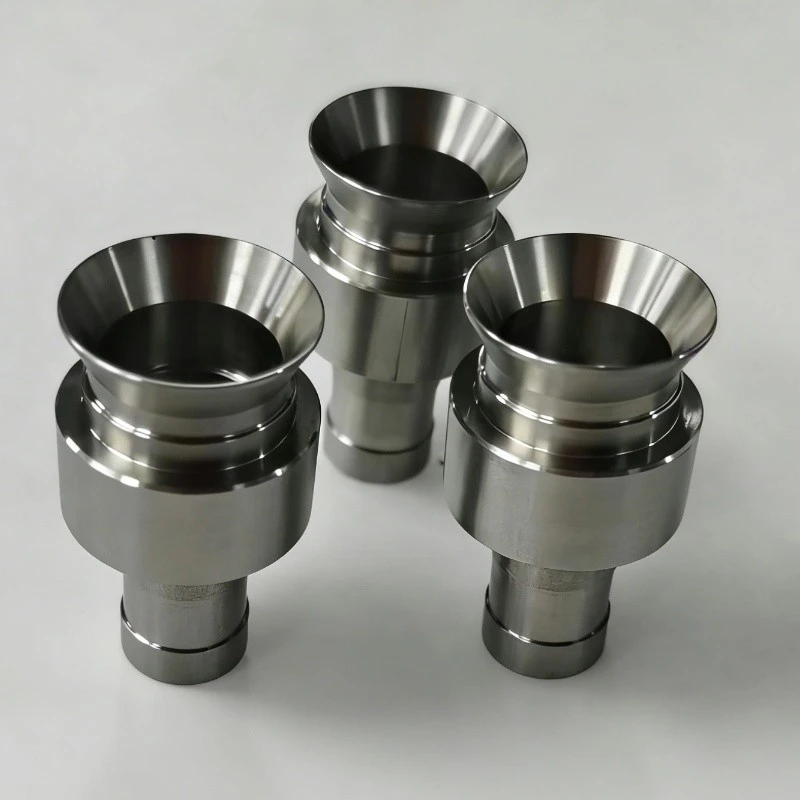

I also want to talk about cost, because I know this is a big concern for many operators. Some people see carbide tools as more expensive upfront, but when you look at the total cost of ownership, they’re actually cheaper than HSS. Let’s do a quick math exercise: suppose an HSS insert costs $5 and lasts 20 parts. That’s $0.25 per part in tooling costs. A carbide insert costs $15, but lasts 120 parts. That’s $0.125 per part—less than half the cost per part. Plus, you save on downtime, labor for tool changes, and scrap. For a 10,000-part run, HSS would cost $1,250 in tooling, while carbide would cost only $1,250? No, wait—correction: HSS is $0.25/part x 10,000 = $2,500; carbide is $0.125/part x 10,000 = $1,250. That’s a $1,250 savings on tooling alone. When you add in the 12 extra hours of uptime (valued at $50/hour, that’s $600), the total savings jumps to $1,850. Over a year, if you run 100,000 parts, that’s $18,500 in savings. The upfront cost is higher, but the long-term savings are massive.
Of course, I don’t want to make it sound like carbide tools are perfect. They are harder and more brittle than HSS, so they can chip if you use improper cutting parameters or apply too much force. But with modern CNC programming and tool holders designed for carbide, that risk is minimal. As a CNC turning supplier, we always work with our clients to select the right carbide insert grade and coating for their specific material and part requirements, and optimize cutting parameters to get the best performance.
At the end of the day, choosing the right tools is just one part of producing great CNC turned parts, but it’s a foundational part. When you pair high-quality carbide tools with a skilled operation, you get parts that are produced faster, with better quality, and at a lower cost. Whether you’re working on stainless steel CNC turning, brass and steel turned components, CNC turned aluminum anodize parts, CNC turning shaft, or precision CNC turned components, carbide tools are the investment that pays off in every stage of your production.
If you’re looking to upgrade your CNC turning operation and see real improvements in efficiency, quality, and cost, our team is here to help. We have extensive experience working with carbide tools across all types of materials, and we can partner with you to find the right solutions for your specific projects. Reach out to our team of experts to discuss your requirements and how we can support your production goals.
References
- “Carbide vs. High Speed Steel Tools: Key Differences and Applications”, Machining.com, 2023.
- “Optimizing Cutting Tools for CNC Turning: Material Selection and Performance”, Modern Machine Shop, 2022.
- “The Impact of Tool Material on Machining Efficiency and Cost”, Manufacturing Engineering, Society of Manufacturing Engineers, 2021.